Ruin (разруха)
The Heart of a DogRuin (разруха) is the social and domestic disorder that Professor Preobrazhensky rejects as an impersonal force. Against explanations that treat it as an external calamity, he locates its causes in everyday conduct: people neglect their responsibilities, misuse shared spaces, and substitute noisy political talk for practical work. The concept connects the deteriorating conditions of Kalabukhov House to a broader dispute over how social change should be understood and addressed.
Domestic Disorder and Its Evidence
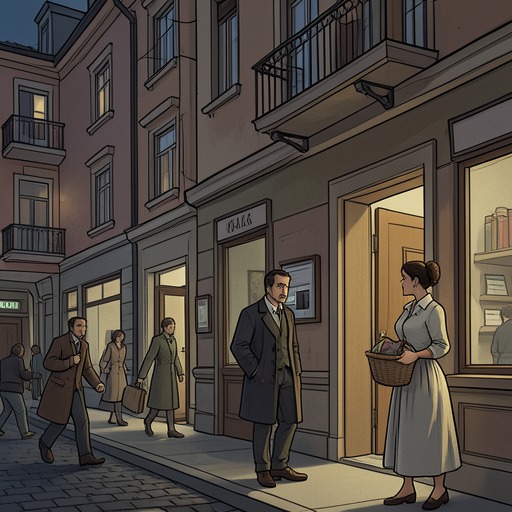
When a general meeting is held again in the house, Professor Preobrazhensky imagines a chain of consequences: community singing in the evening, frozen lavatory pipes, and, eventually, an exploding central-heating boiler. His alarm is grounded in his memory of the building’s earlier order, not simply in abstract nostalgia. He has lived there since 1903, and recalls that before March 1917 no galoshes disappeared from the rack, despite the building’s twelve flats and the steady stream of patients visiting his consulting rooms.
He contrasts that record with the losses and changes that followed: in March 1917, all the galoshes vanished, including two pairs of his own, along with three walking sticks, an overcoat, and the porter’s samovar. The rack subsequently ceased to exist. Meanwhile, the boiler became a further sign of neglect; the marble staircase was dirtied by galoshes and felt boots, its carpet was removed, and the front entrance was boarded up so residents had to use the back door. Professor Preobrazhensky also complains that flowers have been removed from the landing and that electricity, once interrupted only twice in twenty years, now fails regularly each month.
The galoshes make the disorder personal as well as material. When Doctor Bormenthal suggests that proletarians do not own any, Professor Preobrazhensky answers that they do now—and that the galoshes are his, the same pairs that disappeared. He does not establish who took them, but the image of his property being worn by others sharpens his account of how shared domestic order has broken down. His complaint is not only that objects have gone missing; it is that residents have stopped taking care of the staircase and its common spaces.
The Meaning of the Concept
Professor Preobrazhensky refuses to let Doctor Bormenthal describe the building as being in a state of ruin. He calls the word a mirage, vapour, and fiction, then rejects the image of ruin as an old woman with a broomstick or a witch that smashes windows and puts out lights. By giving the supposed force a fanciful, supernatural shape, he exposes what he sees as the mistake in treating disorder as an agent acting on its own.
Instead, he defines ruin through conduct. If he abandoned his evening operations to establish a glee club in his apartment, he says, that would be a step toward ruin. If he, Zina, and Darya Petrovna stopped using the lavatory properly, the lavatory would be ruined. In this account, the physical state of a place follows from what its occupants do there: disorder begins in people’s minds and becomes visible in the rooms, fixtures, and routines they fail to maintain.
Talk, Work, and Political Conflict
The argument extends from the apartment to public life. Professor Preobrazhensky mocks those who shout slogans against ruin while, in his view, neglecting practical work such as sweeping tram tracks and attending to their own responsibilities. His point is not that damaged surroundings are imaginary: he has just catalogued failures and losses in the house. Rather, he denies that denunciation alone can repair them, and presents competent, ordinary work as the means by which disorder could recede.
He pushes this position to a provocative conclusion, proposing a policeman beside every person in the country to moderate citizens’ vocal outbursts. Nothing will improve in the house, he argues, until people stop talking what he considers nonsense; once the chorus ends, the situation will improve. Doctor Bormenthal jokes that the professor sounds counter-revolutionary, but Professor Preobrazhensky rejects the label as another imprecise political term, defending his own remarks as common sense grounded in a lifetime of experience.
Significance
The dispute gives Ruin (разруха) two linked dimensions: the observable decline of domestic arrangements and a contested explanation of its causes. Lost possessions, a neglected boiler, a stripped staircase, and recurring electricity failures make deterioration concrete, while Professor Preobrazhensky’s examples redirect blame from an abstract condition to the habits and priorities of the people who inhabit the building.
His account is inseparable from his own investment in order and professional work. The apartment is both a home and the setting of his medical practice, so the repeated meetings and deteriorating common spaces threaten routines he regards as essential. At the same time, his claim that practical work can make disorder disappear is presented through his own forceful, partisan speech, not as a neutral account accepted by everyone. The concept therefore stages a conflict over whether social breakdown is best understood as an overwhelming historical force or as the cumulative consequence of human choices.